Research Library

Research

Tourism in Central Florida: Why Tourist Development Tax Revenue Should Not Be Diverted

Energy & Environment, Research, Taxes, Tourism

Each year, more than one hundred million visitors come to Florida to enjoy its beaches, warm temperatures, and its numerous parks, thrills, and attractions. Latest FloridaCommerce data confirm that Florida set a new all-time annual record in calendar year 2024 with 143 million visitors an increase of 1.7 percent over the previous record set in 2023. Out-of-state visitors to Florida spent $134.9 billion in calendar year 2024. For every $1 spent by a visitor, 99 cents stayed in Florida’s economy, with 59 cents supporting worker salaries. Tourism supported 1.8 million jobs in 2024 and generated $79.9 billion in wages, including $44 billion in direct wages. Tourism-related activity produced $33.6 billion in federal, state, and local taxes. Tourism accounted for 7.8 percent of Florida’s Nominal Gross State Product (GSP), contributing $133.6 billion to the state’s economy in 2024. Without tourism, Florida households would pay $1,730 more annually in state and local taxes alone to sustain current levels of revenue.


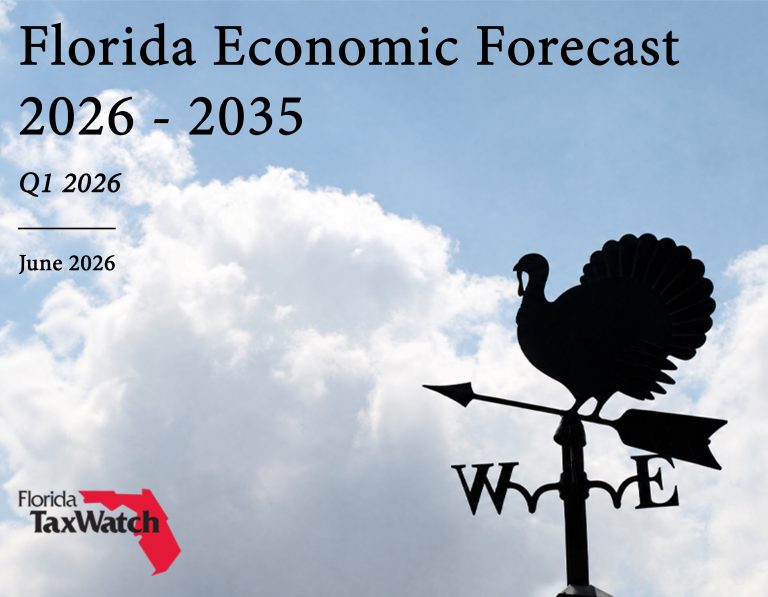
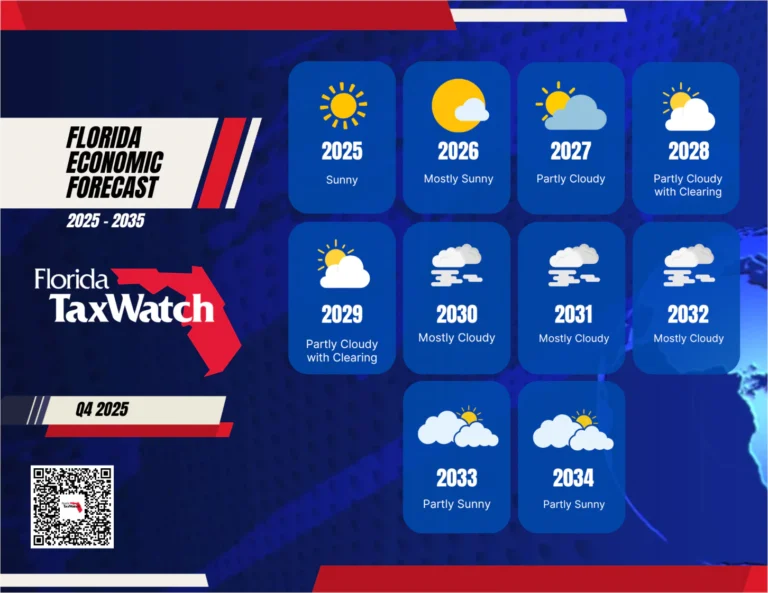
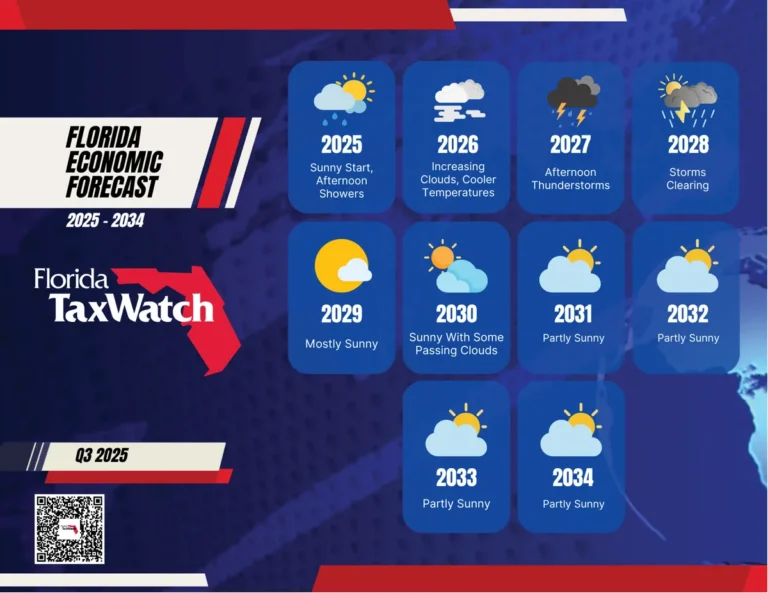
Florida Economic Forecast 2025 – 2035

Economic Forecast, Research

Florida’s economy reached $1.85 trillion in Q3 2025, ranking first among all 50 states and the District of Columbia in economic growth. This fourth installment of Florida TaxWatch’s quarterly economic forecast series — produced in partnership with the Regional Economic Consulting Group — examines whether that momentum is sustainable through 2035.

Building The Force: An Analysis of Florida’s Law Enforcement Apprenticeship Program (LEAP)

Cost Savings, Public Safety, Research, Workforce Development

Florida’s Law Enforcement Apprenticeship Program (LEAP) is helping address persistent officer shortages, particularly in rural and fiscally constrained communities where recruiting and retaining qualified personnel remains a challenge. Traditional pathways into law enforcement often require candidates to pay for training upfront while forgoing income, creating barriers that limit access to the profession.

Clearwater Plan to enter its own municipal

Clearwater’s Plan to Establish Its Own Municipal Electric Utility Puts Taxpayers at Risk

Energy & Environment, Local Government, Public Infrastructure & Utilities, Research

The City of Clearwater is considering acquiring Duke Energy Florida’s electric distribution assets to establish a municipal electric utility (MEU), citing potential rate reductions and increased local control. Florida TaxWatch’s independent analysis finds that the feasibility study supporting this proposal relies on optimistic assumptions that significantly understate legal, financial, and operational risks.

Florida’s Space Coast is Well-Positioned to Dominate the Future of the Aerospace Industry

Economic Development, Manufacturing, Research, Technology, Workforce Development

For more than 60 years, Florida’s Space Coast—anchored by Kennedy Space Center (KSC) and Cape Canaveral Space Force Station (CCSFS)—has served as a premier gateway to space, driving tourism, high-tech jobs, and statewide economic output. After major federal program shifts in the 2010s led to significant regional job losses, Florida’s modern commercial-space resurgence—supported by Space Florida’s strategy to diversify the supply chain, modernize infrastructure, and attract private capital—has positioned the Space Coast to lead the next era of aerospace growth.

Save Our Taxpayers – Property Tax Relief Must be Accomplished Equitably

Housing Affordability, Insurance, Local Government, Research, Taxes

Florida property tax levies have been rising rapidly—increasing by nearly 40 percent in just the last three years and more than doubling in the last ten years—with property taxes now totaling $59.2 billion (FY2025–26). With the Legislature’s increased focus on affordability, especially housing affordability, property taxes are expected to be a top issue during the 2026 legislative session.

Transferring Utility Profits to a Municipality’s General Fund Increases the Risk of Undercapitalization of Water Assets and Violate Taxpayer Accountability

Local Government, Research, Taxes

Setting water utility rates that incorporate the recovery of the costs associated with standard operating expenses and debt obligations is essential to ensuring the short-term and longer-term financial stability of the utility. Once these costs are covered, many publicly owned utilities make transfers to the General Fund (a practice known as “sweeping”) ostensibly to help pay for governmental services that do not generate revenue (e.g., roadway maintenance, public safety, etc.) and to help keep property taxes lower. Keeping property taxes low often means higher municipal utility rates to balance the general budget, a habitual practice that burdens utility customers with cross-subsidies and normalizes underinvestment in infrastructure.

The Fiscal and Economic Impacts of Nova Southeastern University on Florida’s Economy

Economic Development, Education, Health Care, Research, ROI Study, Taxes, Workforce Development

NSU generated an estimated $293.1 million in state and local taxes within the Tri-County region in FY 2024-25 and an estimated $305.1 million in state and local taxes in FY 2024-25.

OH, SNAP! Federal Policy Changes Threaten the Stability of Florida’s Supplemental Nutrition Assistance Program

Budget/Approps, Cost Savings, Federal Government, Health Care, Research

Administered by the United States Department of Agriculture’s (USDA)’s Food and Nutrition Service (FNS), the Supplemental Nutrition Assistance Program (SNAP) provides funds to help low-income households afford low-cost, nutritious meals. In July 2025, President Trump signed the One Big Beautiful Bill Act of 2025 (the OBBB Act), tightening SNAP policies that determine eligibility, benefits, and program administration. Florida TaxWatch undertakes this independent research project to better understand how the upcoming changes in SNAP requirements will impact Florida’s budget and its ability to provide much needed food assistance to needy Floridians.

LUCA Primer: The First Step In Preparing for the 2030 Census

Census, Census Institute, Elections & Apportionment, Local Government, Primers, Research

LUCA Primer: The First Step in Preparing for the 2030 Census explains how Florida’s statistically significant undercount of approximately 750,000 residents in the 2020 Census cost the state an additional U.S. House seat, up to $21 billion in federal funds, and weakened the quality of the data that businesses and community leaders rely on for planning.

Become a Member

Support Responsible
Taxation & Government Spending

For over 45 years, donor support has made Florida TaxWatch the state’s leading independent voice for taxpayer accountability. There are many ways to support our mission.

Scroll to Top